Search This Blog

Subscribe By Email

Get Blog Posts Sent by Email

About This Blog

How to Comment on Blog Posts

The spot for the good news, the good word, the quick reports of the many, many wonderful news items I hear all the time and want to share with the rest of you. Expect to find the good news when you come to check out "what’s the good word?"

Showing posts with label congregational life. Show all posts

Sunday, October 6, 2013

Superficiality and Community


For years now I have read the news on-line vs a newspaper even though in the Toronto market many are free. What I enjoy about the on-line Globe or Star are the comments following the articles. Invariably there are contrary and divergent viewpoints that expand my understanding of issues. Some comments are reactive, some affirmative and some bring brilliant dialogue to the topic which becomes a catalyst for testing the validity of the points expressed. One such interactive dialogue I found so intriguing from the viewpoints posted on all sides (many more than 2 sides to the story) that I copied and pasted the entire 200+ comments onto a word document to enable me to be more informed about the Israeli / Palestine issue which is confusing for me.

There are countless blogs and unlimited dialogue forums on-line about meaningful and diverse subjects. For yourselves, within Facebook there are perhaps a dozen dialogue groups openly discussing any and all topics about our heritage, our theology, our practices, our validity. These forums for me provide insight to the breadth of viewpoints related to our Community of Christ body of people. These forums help me to understand my own faith better as I consider my response to questions posed or perspectives cited. It is not just about protecting my positions of faith. I learn, I grow, I research to verify claims, I am stretched with the new and am enriched. I also always am mindful of our heritage standard to learn by both study and (prayerful) faith.  I would encourage each one to expand your horizons of exposure to faith dialogue. It will also necessitate you knowing your own heritage beliefs with Community of Christ. To know the fundamentals of our faith read the booklet, "We Share" which encapsulates our current enduring principles of faith. If you do not have the booklet, just read it on-line here:

 http://www.cofchrist.org/discernment/weshare/weshare.pdf

To give you a taste of thoughts out there about churches that are being discussed that hold back no punches try these following blurbs people have posted.

"when we are a part of the church, many of us assume that because we are surrounded by people our loneliness will be remedied. Not!  We wonder how genuine the friendships were there in the first place. We were lonely surrounded by people."

I understand the sense of isolation that seems pervasive in church culture. I have spent many hours this past year as a 66 year old trying to determine why this seems to be a characteristic of church community, even in the church that I have been a member of for 35 years and in which I have held leadership positions. When I recently went through a personal crisis, it was my longtime friends and neighbors outside the church community that rushed to inquire about my well being and support me. Interestingly enough, it was not my church "family." I haven't quite figured out the paradox of this situation, but I am working at it.

"going to church could give people the opportunity to mingle with diverse people that are quite different from themselves. In practice, though, many churches tend to attract congregations that tend to be somewhat "the same" and many church communities fear diversity and "the other". In a diverse world when certain communities fear diversity, these "sameness bubbles" will tend to get smaller and smaller. I think that if churches could change their inner psychology and embrace diversity, they could grow their numbers."

"I've never gone to a church where there was ethnic diversity. I have always gone to churches where there was economic diversity. Like you said, the ethnic diversity should have been there, and would have been a great way to get to know and relate to people of other cultural backgrounds. But it didn't work out that way, unfortunately."

"actually, I think the internet is one of the biggest reason for a fall in church numbers.
The internet does two important things:

(1) Community: as related to the post -- it allows community of like minded folks without having to give up 1/4 of your time off each week, drive across town or get dressed up only to have perfunctory nice talks with lots of fake smiles. Well, that is only how church is for some folks.
(2) Knowledge: evidence exposing the foibles of religion are now readily available.
While true that face to face community is important, I think it's important to emphasize a third option on why the Internet may have altered religious practice:
(3) freedom to explore ideas And no topic is considered off-limits. You can share and there will always be someone who can relate, chime in, etc. In the Church, there's too much concern about something being taboo, thus leading to artificial relationships. And our group is not perfect. People say things that offend others, but we're generally quick to make amends without sweeping it under the rug. That doesn't often happen in church. Quite the opposite: the offense is swept under the rug hoping to never be dealt with again. Nothing gets resolved. I'll take real and flawed any day over superficial parading as real and genuine.

Comments like the above challenge us to be relevant, to be real, to explore what needs to change. A full 75% of our total CEM membership is now peripheral to our attending ranks. That says something. Numbers speak volumes. In the sales profession, poor measurables determine the discontinuation of a product or the immediate and critical necessity to change it. Corporate survival is based upon listening, market research, competition, perceived customer benefits, and the cost to acquire that product in comparison to the alternatives. I say it that way as there is a cost to you to attend church in your measurably precious time, your personal inner investment for meaningful intersection with the Divine, courage to engage yourself in social relationships and actual $$ expenditures in gas, contributions etc. Knowing your customer and your customers needs in business creates product loyalty. Loyalty is fading. The comments above about churches are just a small slice of reality in people's thoughts who choose not to attend church.

We need "to be with" those in the periphery or those who are "alone" in our congregations to know them. "With" means personal time, $, courage, prayer and life investment in their lives. Many just fade away otherwise. We are superficial friends if we allow that to happen? Were they lonely in our midst because of superficiality. Is our community of joy, hope, love and peace a future image in our minds or a present reality in our midst. Are we community? These questions are for each of us to ask, to feel deeply within, to have tears over, to take us to our knees and pray for ourselves to change, as we are ultimately that product that needs changing.

I challenge myself and you to be honest, to know there is a cost, to know we need to change things in our lives such as praying intently, having an envisioned plan that compels us, increasing our capacity of time to nurture the reality of community where we are and becoming a catalyst by partnering with others to do the same. It is not easy. I open this blog site's stats and pray for everyone on this blog subscription list every day. May I, may the Spirit be a catalyst in yours and my life!!

submitted by Kerry

Wednesday, February 1, 2012

Welcome!


One of the leading principles in the Old Testament, and down into the New Testament, was the principle of hospitality. The people in “bible times” were really serious about their hospitality. All you had to do was show up at the tent, door, well, whatever, and request the hospitality of the “Patriarch” and they were duty bound to provide for you.

As a matter of fact, this principle of hospitality was so very important that scriptures tell us that the lack of hospitality was one of the major “sins of Sodom” and the reason for its destruction. In the Bible, hospitality packed quite a punch!Let’s bring this down to today. Imagine if you will, a 19 to 20 something, dressed in black combat boots, jeans, a black t-shirt, a red and black “lumber jacket”, jet black hair hanging over half of his/her face, comes strolling through your church doors on Sunday morning. What might your reaction be?

Let me tell you about a reaction that truly impressed me.

I travel a fair bit in the Mission Centre and speak at Community of Christ congregations and other congregations of different denominations. My oldest son has been doing a bit of travel with me and we stumbled onto something. I started dropping Palmer off at the door, going and parking and then coming in myself. What we have experienced was really quite surprising!

At a Community of Christ congregation that is really serious about the Mission Initiative, “Experience Congregations in Mission”, when I came in I was greeted by a dear old friend but Palmer was nowhere to be seen. As soon as he had come through the door someone had spotted him, told him that everyone who came to that church had breakfast in their fellowship hall, took him there, got him set up with what he would need and went to get him a coffee. Another person asked him if he played any musical instruments and he replied that he played the bass guitar. Hearing that she exclaimed, “Wow! We really need a bass guitarist!”

The people who were with Palmer were later surprised when one of their own children told them that I was Palmer’s dad. Later that day, as I was taking Palmer home, he said, “WOW Dad, I could go to that church. The people were great!”

I guess that my question would be, what might happen if we all took the lesson of hospitality to heart? What kind of difference might it make today? How might generous hospitality serve in the Mission Initiative, Invite People to Christ or even Develop Disciples to Serve? What kind of “punch” might hospitality pack in the 21st century Community of Christ?

Take a stand to the side some Sunday, what do you see? The Canada East Mission Centre is ready to help with hospitality. Mike Hewitt has an excellent course on Hospitality that he can bring to you!

Poster is John Nichols

Friday, September 30, 2011

Dinner

It's not exactly "dinner" that I want to talk about. But I couldn't really put it all into a single word, so "dinner" is what you get.

I was reading this essay about Shared Meals earlier today and I've been thinking about it ever since. While I don't always agree with everything on this site for Christian women, I can count on them to force me to think!

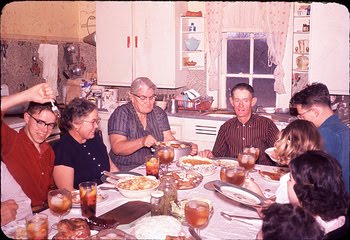
I remember well my own family dinner table. (I've shared this before). We always ate together. We always sat in the same place. I was down there at the end; my left-handed brother sat at the corner so his elbow wouldn't conflict with anyone else's space. Much conversation happened at our table. Many lessons were taught and learned--some obvious, some not-so-much.

Much is written these days about ways our culture has changed. Many a comment has been made about the loss of the family dinner table. The essay I referenced earlier speaks of the changes in hospitality, the need for congregations to find ways to resurrect the shared meal, the importance of modeling Jesus' teachings about the common table.

Congregational practices around "pot luck" that informal ninth sacrament always generate lively discussion. Small groups and new groups (think Barrie) --ask them how often the eat together! It's one of the best ways we know how to bond a community into something tight and real.

Listen to the "experts" on family dynamics and the psychology of children or teens and pretty soon, you're likely to hear them talking about the need to establish, or re-establish the practice of eating together as a family. They'll advise you to turn off the television, remove the ear-buds and sit together at the table and to make it a habit.

I am really quite aware that I haven't offered you much in the way of answers. I'm quite conscious of the barriers that exist--the time crunch, the sports and school schedules, the allure of fast and pre-prepared meals, the dearth of time and volunteers to manage the congregational communal meal. But what do you think? Have we lost something that we should be reviving? Have we managed to hold onto something we want to keep? Is there something theological here that we might need to think about more deeply?

If you've got thoughts on this, please share. If you'd like to raise some more questions that's OK too. But if you've got answers toss them into the mix as well.

Posted by Marion

Wednesday, September 21, 2011

Meetings


If you do a search on this word, one of the items very near the top of the list is likely to be this offering "meetings, bloody meetings." I guarantee, if you utter the word "meetings" in most any gathering, someone will respond with some similar (if not identical) derogatory statement. It seems to be fashionable, acceptable, normal to hate meetings!

Why is that? Mainly I think it's a bit of a self-fulfilling thing. Because we tend not to like meetings, we don't give them the kind of attention they need and deserve. Therefore we approach our meetings without giving them adequate thought or planning. And they turn out accordingly. And we are confirmed in our opinions that meetings are things to be scorned.

I spoke the other day about congregations getting back to a regular schedule of activities. Maybe you're also returning to thinking about your meetings. Here's a tiny bit of advice, hopefully to help you.

Consider that in any organization--as small as a family, as large as a corporation or even a country--there need to be be two kinds of meetings. One is the Regular Meeting. It's called "regular" because it kind of regularizes who we are. This is the time we get together and look at each other and remember we belong together. We remind each other of our overriding vision and purpose and recall our priorities and values. We look around and notice our leaders, our leaders-in-training. We hand out certificates of appreciation, or long-service, or even retirement. We observe how we're organized and we celebrate who we are.

Think family holiday dinners, openings of parliament, annual stock-holders' meetings, the congregational budget meeting (perhaps).

Then there are the Working Meetings. This one is plural, because we have many more of these than we do Regular meetings. These are the generally much smaller groups who need to get together to gather information, figure out the critical questions, assign tasks to individuals or task forces, report back on how our task is going, brief and de-brief each other as we work towards our specific piece of the priorities we've shared at our regular meeting. They can be lots shorter, maybe even just touching base on the phone.

This lesson could go on much longer, with lots more helpful tips about agendas and memory systems, but you've got the critical piece. Much of the time we mix up our purposes and try to cover too much. We think "if we've got these people here we'd better get it all done." We'd be better to keep them separate, and clearly so. Consider your meeting; decide which type it is; make sure everyone knows that; organize to serve the announced purpose. Doing this much should make your meetings work better and make your people appreciate what you've done and be more willing to attend your meetings.

I hope this helps.

Posted by Marion